OBSIDIAN
22 SRC
Obsidian
This synthesis records claims and practices from the cited sources; reported outcomes and product capabilities have not been independently verified.
Obsidian remains the dominant IDE for LLM-maintained knowledge bases, with the architecture anchored by Web Clipper ingestion into raw/, agent-compiled markdown with backlinks, and Marp for slides. The community standard is now "vault as foundation, Claude Code as engine"—plain-text markdown that agents read and maintain while humans rarely edit. Vaults split into raw/ (unmodified sources) and wiki/ (agent-maintained knowledge). Retrieval treats the vault like a codebase: an 18-line root index avoids embeddings entirely. Karpathy's key motivation was moving from Notion to Obsidian specifically to use Claude Code and link code context with writing, letting AI act as advanced in-document search across thousands of words instead of requiring elaborate tagging systems.
Vault wiring lives in ~15 lines of global AGENTS.md; outside the vault, agents connect via Local REST API. Two MCP servers bridge agent and vault. Pre-commit hooks and weekly agent passes maintain structural integrity. Tolaria (10,000-note proof, 100K+ LOC, 85% coverage) layers Git and MCP atop plain markdown; ByteRover unifies fragmented notes into relevance-scored indexes. HTML artifacts serve as interactive layers above markdown. Excalidraw (110K stars, end-to-end encrypted) is the de-facto diagram primitive. Google's Open Knowledge Format may displace Obsidian as storage layer while workflow patterns persist.
Guides
Insights
Obsidian Headless now supports Publish so you can publish to your website without using the Obsidian desktop app, and Sync has a headless client for server-side vault automation (from obsidian headless publish sync)
Obsidian + Claude Code is a recognized community pattern — the "vault as foundation, Claude Code as engine" architecture uses plain text markdown that any AI agent can read directly (from dev browser sawyerhood)
Use Obsidian Web Clipper extension to convert web articles to .md files; set up a hotkey to download all related images locally so LLMs can reference them in knowledge compilation (from llm powered personal knowledge bases)
Use Obsidian as the IDE frontend where you view raw data, the compiled wiki, and derived visualizations — LLM writes and maintains all wiki data, humans rarely touch it directly (from llm powered personal knowledge bases)
Marp plugin in Obsidian renders LLM outputs as slide shows; filing query results back into the wiki means every exploration enhances it for future queries — the wiki compounds through use (from llm powered personal knowledge bases)
In the LLM agent era, share abstract "idea files" (gist format) instead of specific code — another person's agent reads the idea and customizes/builds it for their specific needs, keeping it intentionally vague enough to support many directions (from llm personal knowledge base workflow)
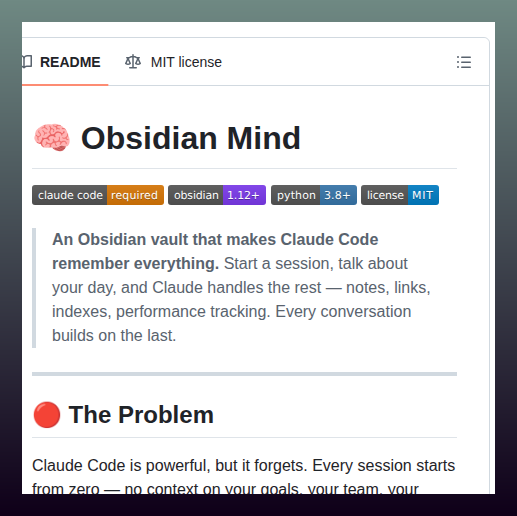
Obsidian vault purpose-built for Claude Code memory (obsidian-mind project) — combines Obsidian's knowledge management with persistent coding context across sessions (from obsidian vault claude code memory)
Two MCP servers bridge Claude and Obsidian vault: smart-connections (semantic search over entire vault — finds notes without exact titles) and qmd (structured queries, collection management, metadata operations for precise retrieval by path or tag) (from nyk builderz shared link)
brain-ingest tool processes video/audio locally (no data leaves machine), extracting 12-18 claims, 3-5 frameworks, 5-8 techniques from a single 90-minute talk — structured knowledge notes vs. raw transcript noise, dropped into vault inbox for review (from nyk builderz shared link)
Agents handle the maintenance that killed every wiki — they notice contradictions between notes, specs out of sync with codebases, and propose structural changes to the system itself when current architecture creates drag (from nyk builderz shared link)
KB Tools Built for Agent-First Workflows
Cabinet (open-source on Claude Code) packages document processing + KB + inline web app: agents with heartbeats and scheduled jobs ingest CSVs/PDFs and operate the workspace, all stored as markdown on disk with no vendor lock-in — implements Karpathy's LLM-wiki concept directly (from cabinet llm knowledge base tool)
Tolaria (open-source macOS) is a markdown KB management surface explicitly built for AI collaboration — Luca Rossi runs his 10,000-note vault on it; 6 years of Refactoring notes, AI agents create/edit/connect notes, "in a way it's my implementation of Karpathy's LLM wiki" (from tolaria markdown knowledge base app)
Tolaria provides a Git-based knowledge vault stored as plain markdown (no vendor lock-in) with visual version history directly in the app — Git versioning becomes a first-class KB feature, not an external concern (from tolaria llm wiki app karpathy)
Tolaria ships an out-of-the-box MCP server so Claude and other AI tools natively read and edit the vault without external integrations, with a modern block editor designed as a shared human/AI environment (from tolaria llm wiki app karpathy)
Tolaria is itself a proof point for AI-assisted engineering: 100K+ lines of code, 3,000+ tests at 85% coverage, 9.9/10 code-health score on a Tauri/React/Rust stack (from tolaria llm wiki app karpathy)
ByteRover unifies scattered knowledge from Obsidian, GBrain, wikis, and forgotten markdown files into a Claude/Claude Desktop relevance-scored index — solves the knowledge-fragmentation problem when notes live across multiple tools (from byterover unified knowledge search)
HTML Artifacts as the Interface Layer
Combine LLM wikis as the knowledge foundation with HTML artifacts as the interactive interface layer to create dynamic agent-connected workflows — deploy HTML + Markdown together rather than replacing one with the other to maximize both structured capture and interactive presentation (from llm wikis html artifacts workflow)
Build HTML artifacts that communicate bidirectionally with agents, enabling automated inbox management, research scheduling, and topic discovery, and use them for fast prototyping and deep research that layers atop the wiki knowledge base as workflow needs evolve (from llm wikis html artifacts workflow)
Obsidian is now embedding Excalidraw alongside Google Cloud, Meta, Notion, and HackerRank — the 110K-star whiteboard with no signup, infinite canvas, and end-to-end encryption is the de-facto diagram primitive for plain-text knowledge stacks (from excalidraw free miro alternative)
Open Knowledge Format as Obsidian Alternative
- Google's Open Knowledge Format (OKF) standardizes information storage in a directory of markdown files — creates a structured "digital brain" that agents can query and edit programmatically, potentially replacing Obsidian and Notion for knowledge management (from google open knowledge format okf launch)
- OKF enables living wikis with interlinking capabilities that agents can both read from and write to, with the specification available at GoogleCloudPlatform/knowledge-catalog GitHub repo (from google open knowledge format okf launch)
vault-architecture
- Vault splits into raw/ (unmodified clipped articles, transcripts, journal entries — sources never rewritten) and wiki/ (agent-maintained knowledge layer: small cross-linked pages, one concept per file, frontmatter with type/sources/dates). Human reads, agents write. (from karpathy style obsidian vault two layer architecture)
- Retrieval avoids embeddings entirely: an 18-line root index points to folder indexes, each folder index lists pages with one-line descriptions; agent drills root → folder → page → grep for specifics, treating the vault like a codebase. (from karpathy style obsidian vault two layer architecture)
- Vault wiring lives in ~15 lines of a global AGENTS.md; outside the vault, agents connect via Obsidian's Local REST API plugin. (from karpathy style obsidian vault two layer architecture)
vault-maintenance
- Maintenance automation: a pre-commit hook lints every change for broken wikilinks, missing frontmatter, orphaned pages, and passed deadlines never resolved; a weekly agent pass checks for contradictions and stale status lines — without this the vault would rot. (from karpathy style obsidian vault two layer architecture)
AI writing workflow
- He moved from Notion to Obsidian specifically to use Claude Code and link code context with writing, letting AI act as 'advanced in-document search' across thousands of words of notes/drafts instead of requiring an elaborate tagging/backlinking system. (from how i write with ai)
Voices
22 contributors

Charly Wargnier
@DataChaz
🦞 Clawdbot / @openclaw tinkerer • Ex @Streamlit @Snowflake Maestro • Also tweet about AI agents, LLMs, and web apps • My ❤️ is open source • DM for collabs 📩
Andrej Karpathy
@karpathy
I like to train large deep neural nets. Previously Director of AI @ Tesla, founding team @ OpenAI, PhD @ Stanford.


Marie Haynes
@Marie_Haynes
SEO & AI Consultant Building agents & other cool things with 🤖Antigravity 🦾Workspace CLI 📙NotebookLM AI & SEO News: https://t.co/zdw5sWdbKq

Tom Dörr
@tom_doerr
Follow for posts about GitHub repos, DSPy, and agents Subscribe for top posts DM to share your AI project (Due to volume of DMs I'll prioritize subscribers)


Ole Lehmann
@itsolelehmann
I help non-technical people make more money with AI agents. AI connoisseur, robotics maxi, eu/acc supporter, dad, techno optimist


Nav Toor
@heynavtoor
Helping you master AI daily with step-by-step AI guides, latest news, & practical tools • DM for Collabs


CyrilXBT
@cyrilXBT
AI • Crypto | Sharing what I see before everyone else does
Dan McAteer
@daniel_mac8


GREG ISENBERG
@gregisenberg
I drop startup ideas daily. Host @startupideaspod. CEO: @latecheckoutplz we build companies like @ideabrowser, @meetLCA, @boringmarketer etc


Nick Spisak
@NickSpisak_
| AI Transformation Engineer | Seven Figure E-Commerce Business Owner

Nick Khami
@skeptrune
currently doing things at Mintlify, prev. built a search API (trieve acq. YCW24), you should try to fail faster
Moysei
@0xMoysei


Graeme
@gkisokay
AI agent enjoyer | Founder @amplifi_now | Building better agents


Hila Shmuel
@HilaShmuel
builder of Cabinet, LLM+KB 🗄️https://t.co/AdFsg7tZfT Ex-Software Engineering Manager at @Apple 🍏👠
Ian Vanagas
@IanVanagas


andy nguyen
@kevinnguyendn
Creator of https://t.co/EMx6p0sbuD | Building an agentic memory layer for coding agents to help millions of devs vibe code better! 🚀 #VibeCoding


Luca Rossi ꩜
@lucaronin
📬 Author of https://t.co/mtplxYUOk4 • I write weekly about making software and working with humans, to 120K+ engineers. 🏎️ Sim racer @SimRacingLG


Nyk 🌱
@nyk_builderz
co-founder @builderzdotdev | founder @splitlabsio | member @superteamDE | building AI agents + solana apps | open source | DM for builds.


Obsidian
@obsdmd
The free and flexible app for your private thoughts. For help and deeper discussions, join our community: https://t.co/1RE4oF63hR


Orca IDE
@orca_build
A cross-platform AI Orchestrator for the 100x devs


Reflect
@reflectnotes
Tools for thought.
Sebastian Kehle
@sebastiankehle