BRAND AND DESIGN
42 SRC
Brand and Design
This synthesis records claims and practices from the cited sources; reported outcomes and product capabilities have not been independently verified.
Brand design with AI succeeds through constrained systems anchored in professional foundations—layout templates, reference deconstruction, and systematic design rules. The proven workflow sequences brand creation as Reference → Deconstruction → Anchor (Brand Kit) → Guidelines → Brand Lock → Campaign Assets → Packaging, with mandatory human approval between stages to prevent wasted generation credits. AI excels at filling detail but fails at hierarchy; the solution is instructing agents to extract composition, typography, color logic, and signature devices from references, then generate original work rather than copies. First-draft brand kits suffer from incoherent mixing of materials and devices; fixing requires subtractive design—more white space, fewer graphic devices, one clear direction. Brand Lock methodology defines which attributes lock to approved sources (Brand Kit controls typography and color; references inform only shot type and lighting), preventing visual drift across campaigns. Precision editing tools (Text Edit, Touch Edit) refine full-generation outputs rather than generating from scratch, keeping generation and refinement as separate phases. Typography and color discipline—four type sizes, three text colors, fixed radii—drive polish more reliably than component libraries. Motion animations, especially page-level effects, credibly multiply perceived quality. AI-generated packaging visualizations are conceptual only, not production-ready specifications. Ultimately, brands are defined by human decisions about locked visual language; agents explore and generate, humans judge and systematize.
Guides
AI Design Without Designers: Constraining AI for Professional-Grade UI
How to get polished, credible UI from AI tools by constraining them with layout skeletons, Dribbble references, and single-color palette generators — plus the emerging tools (OpenBrand, Gemini identity systems, shadcn theming) that make one-person design teams viable.
Claude & Claude Code for Marketing Agencies: A Detailed Guide
A comprehensive guide covering agency workspace setup, content strategy, competitive intelligence, outbound automation, brand design workflows, and agency-specific Claude Code skills — grounded in 77+ sources.
Keyword Research → Optimized Landing Pages: The Workflow
A four-stage workflow using Claude Code to turn a keyword list into optimized landing pages — covering competitive intelligence, content briefs, one-shot page generation with design constraints, and automated monitoring loops.
Insights
- "Bento videos" -- grid-based visual showcases of product features -- have become a recognized brand design format, prominent enough to warrant dedicated curation alongside intros and demos (from branding bento video resource)
- Gemini is being positioned as a brand identity generation tool, with structured multi-step prompt sequences producing logo concepts, visual direction, and full brand identity systems without a human designer (from gemini prompts brand identity)
- AI-generated brand assets are becoming viable for MVPs and early-stage products where speed and cost matter more than pixel-perfect craft -- strong demand from indie hackers and founders who cannot afford agency work (from gemini prompts brand identity)
- OpenBrand is an MIT-licensed tool that extracts logos, colors, and brand assets from any URL automatically, solving the brand-asset-ingestion problem for B2B SaaS products that need to white-label or personalize per customer (from openbrand extract brand assets)
- The absence of an existing open-source URL-to-brand-asset extraction tool before OpenBrand suggests this is a common but overlooked developer need (from openbrand extract brand assets)
- Component-level design inspiration sites (navbar.gallery, cta.gallery, appmotion.design) provide granular references for specific UI patterns, while broader sites (curated.design, landing.love, saaspo.com) cover full-page design (from design inspiration sites list)
AI-Constrained Design Workflows
- AI is strong at filling in UI details but fails at creating visual structure from scratch -- the fix is providing pre-built layout skeletons from professional UI block libraries like Tailark, Tailwind UI, or shadcn blocks (from ai ui layout technique)
- The principle "give AI constraints and it becomes a weapon" applies broadly: AI performs best when given a professional skeleton to build on rather than a blank canvas (from ai ui layout technique)
- A growing pattern among vibe coders: screenshot UIs from Dribbble, feed them to Claude as design inspiration, and have it generate CLAUDE.md style guides -- producing professional-looking products without hiring designers (from dribbble design reference for claude)
- Dribbble has found an unexpected second life as a source library for AI-assisted design workflows, even as the platform itself had faded from relevance in traditional design circles (from dribbble design reference for claude)
- There is an unresolved ethical tension between "design inspiration" and copying when AI mediates the translation from screenshot to implementation (from dribbble design reference for claude)
- Claude produces poor UI when freestyling dashboard designs; the fix is to constrain it with an enterprise-grade open-source dashboard as a reference and map features onto that design system (from claude dashboard ui design hack)
- The convergence of AI-generated UI quality with marketing design standards means differentiation increasingly shifts from visual execution to strategy and positioning (from opus marketing ui)
Design Tools and Systems
- shadcn/ui's biggest adoption problem is not components but theming -- projects look identical or broken because color palettes, font pairings, and dark mode are afterthoughts (from shadcn theme generator)
- A single-color-to-full-palette generator with built-in contrast checking solves the most common design system pain point: maintaining accessibility while creating cohesive visual identity (from shadcn theme generator)
- The Figma-to-code bridge (copy CSS or import to Figma kit) reflects the industry need for design tools that work bidirectionally between design and development environments (from shadcn theme generator)
- Vercel built a custom Mermaid theme with animations as a Diagram System, extending design systems beyond UI components to include documentation artifacts for visual consistency across developer-facing content (from vercel mermaid diagram system)
- A Figma plugin that takes reference designs + brand guidelines and generates editable vector SVGs directly on canvas represents the next wave of AI-assisted design: not replacing designers but generating first drafts they can edit (from figma plugin ai ui generation)
UI as Credibility Signal
- High-quality UI design is a credibility multiplier -- a polished interface can make an early-stage company feel like a billion-dollar operation (from world class ui billion dollar)
- Design agencies positioning themselves around speed + polish (not just quality) are adapting to a market where AI raises the baseline and execution speed becomes the differentiator (from world class ui billion dollar)
- Polished dashboard UI with sales management data visualization demonstrates the trend of design-forward SaaS interfaces as competitive differentiator (from sales management dashboard)
AI-Product Design Patterns
- Intercom's case study shows that simplifying product navigation can create space for AI features -- reducing UI complexity is a precondition for integrating AI capabilities into existing products (from intercom navigation simplification)
- The "AI Interaction Atlas" is a pattern library for human-AI interaction design, signaling that AI UX is maturing enough to warrant its own dedicated design system separate from traditional UI patterns (from ai interaction atlas)
- Claude Code can generate design systems and architectural diagrams from an existing app codebase, extending its utility beyond code generation into design artifact creation (from claude code designer harnesses)
AI-Generated Mockups Replace Prototyping
AI image-generation in Codex one-shots full UI mockups with prompts like "make a screen in the Codex App on a Mac desktop that is an AI code review view for PRs" — internal teams sharing product ideas via generated images instead of building click-through prototypes (from ai image generation ui prototyping codex)
"Something about AI generated images of digital surfaces feels very right" — image models excel at synthesizing screens, hero sections, and dashboards because they've been heavily trained on these patterns, integrating into dev tools as full-stack design engineering (from ai image generation ui prototyping codex)
Training Agents on Good Design
- Refero ships 2,000 DESIGN.md files extracted from top products — colors, typography, spacing, layout patterns formatted for AI consumption; addresses why agents produce ugly UIs (they've never seen good design) and packages exposure as in-context training data (from refero design systems ai agents)
- Refero Styles is positioned as a searchable curated DESIGN.md library — agents query the catalogue for proven patterns at generation time rather than relying on a designer to pre-select references, turning design taste into a retrieval problem (from refero design systems ai agents)
- Google's open-source Design.md format captures a brand's design DNA (typography, colors, spacing) in a single markdown file that AI agents reference for consistent output — the configuration-as-design-system pattern (from google design md ai consistency system)
- Instead of designing from scratch, study existing brands (Linear, Stripe, Vercel) and use ChatGPT or Claude to extract their design language into your own design.md — reverse-engineering proven taste rather than generating it (from google design md ai consistency system)
- Build modular AI skills (landing page, mobile app, motion design, slide deck) that all reference the same design.md, so a single source of design truth produces a unified brand experience across every touchpoint and makes startups look professionally designed (from google design md ai consistency system)
Hand-Drawn Aesthetic and Diagram Primitives
- Excalidraw's hand-drawn aesthetic (110K stars, used by Google Cloud, Meta, Notion, Obsidian) makes complex diagrams feel approachable rather than corporate — the rough/sketchy look is itself a design choice that lowers perceived stakes for early-stage exploration (from excalidraw free miro alternative)
minimal product design
- Rows (rows.gg) is a shared multiplayer list tracker with a minimal data model: name, priority, status, person. Built originally for Lightspark's daily design sync, it generalized to reading lists, apartment hunts, etc. (from rows simple tracker launch)
- Rows deliberately omits dashboards, automations, and AI assistants. Design rationale: fewer features means nothing to learn and nothing to break — omission as a first-class design decision, not a limitation. (from rows simple tracker launch)
- Realtime multiplayer is shown via live cursors with teammates' faces attached, turning a shared list into a 'room' rather than a spreadsheet-feel collaboration surface. (from rows simple tracker launch)
- Instead of unread counts or digest emails, Rows marks changes made while you were away with a personal 'New' chip that disappears once you've actually viewed that row — passive catch-up rather than notification overload. (from rows simple tracker launch)
micro-interaction craft
- Completing a row triggers a fuse-sweep and spark animation with an incrementing archive counter; killing a row burns it to 'carbon' and removes it visually, but the underlying data stays fully recoverable in the archive — destruction is purely cosmetic, not destructive. (from rows simple tracker launch)
- Every action in Rows (creating a row, editing, completing, etc.) has a dedicated real sound effect served from the app's own asset folder, not a demo dramatization — an example of investing craft into non-essential sensory feedback. (from rows simple tracker launch)
- Rows supports full keyboard shortcuts for every action (create, move, complete, kill) alongside full mouse/drag support with spring-physics feedback when grabbing and releasing a row — dual-input parity as a design principle. (from rows simple tracker launch)
typography-system
- Constrain UI typography to a small fixed scale: SF Pro Regular/Medium at -0.15px letter spacing, with only four sizes used — 12px, 13px, 14px, and 24px. (from clean ui blueprint typography color spacing system)
color-hierarchy
- Build visual hierarchy with just three text colors: #292929 (primary), #5D5D5D (secondary), #9E9E9E (tertiary) — avoiding an expanding gray palette. (from clean ui blueprint typography color spacing system)
icon-sizing
- Size icons contextually: 14px for navigation icons, 20px for card icons — matching icon scale to UI region rather than using one global size. (from clean ui blueprint typography color spacing system)
spacing-radius-rules
- Use consistent corner-radius rules by component type: 8px for navigation elements, 16px for cards, and full pill radius for CTAs. (from clean ui blueprint typography color spacing system)
design-systems-philosophy
- Design claim: constrained, repeatable systems (limited type sizes, fixed color tiers, fixed radii) produce polished products more reliably than ad hoc per-screen styling decisions. (from clean ui blueprint typography color spacing system)
dev tool UI design
- Post references a dashboard UI design example for a complex dev tool, shared as an image link without accompanying text explanation of design rationale. (from dashboard design dev tool)
design-process
- Design process (from Christopher Alexander's 'Notes on the Synthesis of Form'): 1) lay out constraints, 2) generate solutions satisfying them, 3) revisit constraints if feedback reveals gaps—loop back to step 1 rather than patching solutions directly. (from how i design with ai matt dailey)
- The common failure mode is 'design wackamole': skipping constraint re-evaluation and spot-fixing symptoms (e.g. 'make X more prominent') when user feedback arrives, which creates a disjointed patchwork prioritizing some interactions arbitrarily over others. (from how i design with ai matt dailey)
- Workflow: maintain a running document of minor UI 'papercuts' instead of reactively fixing each one; ship obvious fixes immediately but batch small annoyances for a cohesive redesign later, avoiding accumulated patchwork mess. (from how i design with ai matt dailey)
ai-agents-in-design
- AI agents exacerbate wackamole design by readily executing narrow prompts like 'add an affordance for Y' without questioning whether the underlying constraint set needs revision—mirroring how agents add unnecessary try-catch/utility duplication in code. (from how i design with ai matt dailey)
- AI design agents systematically over-add (extra copy, lines, icons, belt-and-suspenders elements), producing UI that looks polished but is functionally worse—counteract by auditing every element and asking 'do I actually need that?' (from how i design with ai matt dailey)
design-tooling
- 'Prototype gravity' risk: building the first design version directly in the production codebase creates inertia to just refine that version rather than exploring alternatives, and forces the agent to graft onto existing real-app constraints prematurely—iterate in a dedicated design tool (Figma, Cursor Design Mode, Claude Design, HTML prototypes) generating 3-4 variants first. (from how i design with ai matt dailey)
- At Ref, a /showcase page is used for agents to build and iterate on UI components in isolation before wiring them into the main app, enforcing separation of views/logic and reusable component libraries for visual cohesion. (from how i design with ai matt dailey)
- For features spanning frontend and backend, Ref splits PRs by layer: backend changes get unit/integration test verification, frontend changes require human review via preview deploys with real backend data—since even agent-built designs matching spec often still need adjustment once seen with real data. (from how i design with ai matt dailey)
agent-readable design systems
- A free library packages 2,000+ products' design systems as DESIGN.md files—markdown docs covering colors/tokens, typefaces/sizes/weights, spacing/layouts, component styling, and explicit use/avoid rules—readable directly by Codex and Claude Code. (from design md library)
- Workflow: pick a reference product (e.g. Linear, Notion, ElevenLabs, Lamborghini) whose design language fits your product, drop its DESIGN.md into the project directory, and have the coding agent either build a new UI from scratch or refactor an existing one to match those rules. (from design md library)
design-motion
- Claim: the fastest way to make a landing page feel expensive is motion that belongs to the page itself, not more copy or another hero screenshot. (from animated visual components shadcn)
- A set of 25 fully customizable animated visual components (React/shadcn/ui compatible) was shipped as a replacement for plain icons and abstract images on landing pages. (from animated visual components shadcn)
- Creator signals roadmap: an Astro design system and 'agent skills' integration are planned next, suggesting animated component libraries are being extended toward agent-driven design workflows. (from animated visual components shadcn)
AI branding pipeline
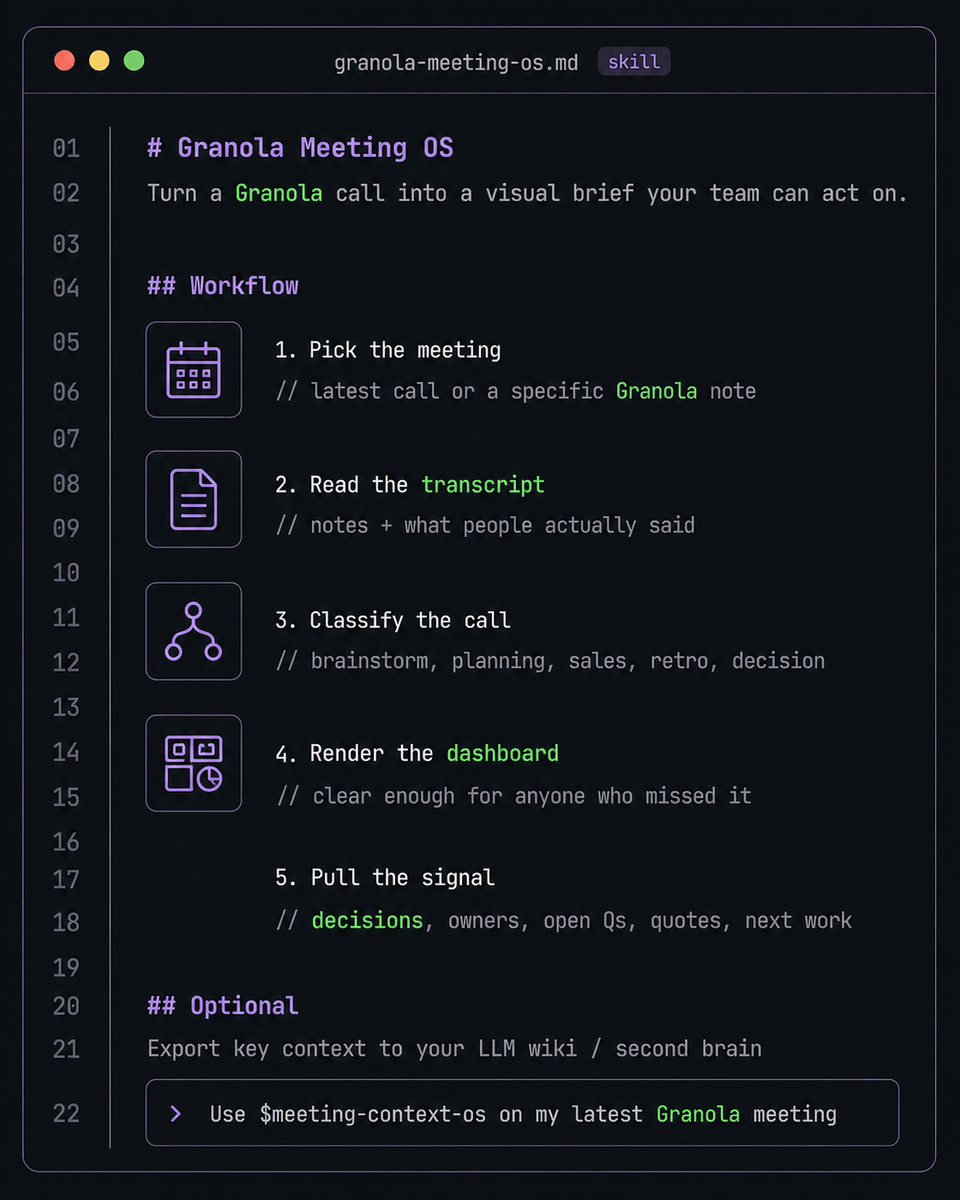
- Branding workflow sequence: Reference → Deconstruction → Anchor (Brand Kit) → Guidelines → Brand Lock → Campaign Assets → Packaging. Each stage requires human approval before advancing to prevent wasted generation credits. (from lovart brand system workflow)
- First-draft AI brand kits often fail from lack of hierarchy—mixing realistic materials, mascots, icons, and multiple micro-directions into one incoherent board. The fix is subtractive: 'more white space, less graphic devices, one clear direction' rather than generating more content. (from lovart brand system workflow)
- Precision editing tools (Text Edit, Touch Edit, Edit Elements) are applied after full-asset generation for targeted corrections, rather than being used to generate assets from scratch—keeping generation and refinement as separate workflow phases. (from lovart brand system workflow)
- AI-generated packaging concepts (front, three-quarter, isometric, exploded views) are explicitly conceptual visualizations only—not production-ready dielines, vector artwork, prepress files, or manufacturing specs. (from lovart brand system workflow)
Reference deconstruction prompting
- Instruct AI agents to analyze a reference as a creative director: extract composition, typography, color logic, signature device, and product hierarchy—then translate those principles into an original identity rather than copying the image directly. (from lovart brand system workflow)
- 'Brand Lock' is a methodology (not a single prompt/button) for defining which reference source controls which output attribute—e.g., new scene references only inform shot type/lighting/camera, while an approved Brand Kit remains sole source of truth for typography, color, and product design—preventing visual drift across expanded campaign assets. (from lovart brand system workflow)
Agent tooling for design
- Seedance 2.5 (video model inside Lovart) was used to extend a locked static brand system into motion assets, using the same approved packaging, colors, and typography as source of truth, then finished in Adobe—demonstrating cross-modal brand consistency on one agent canvas. (from lovart brand system workflow)
Human-AI role division
- Core thesis: AI agents can generate endless image variations, but a brand is defined by human decisions about what must stay locked in the visual language—the agent's role is generation/exploration; the human's role is judgment, rejection of contradictions, and system definition. (from lovart brand system workflow)
Voices
42 contributors
Adham Dannaway
@AdhamDannaway
📘 Author of @PracticalUI ⚡️ UX & UI design tips, inspiration, & news 🤟 Pushing pixels since 2005 ⚙️ Specialised in UI design & design systems


Sujon Hossain
@sujon_co
Founder https://t.co/snH2zr0eXh • Trusted by 55+ Companies Worldwide • Product Designer for SaaS & Fintech • Expert in Framer & Webflow → Whatsapp: +8801701253995


GREG ISENBERG
@gregisenberg
I drop startup ideas daily. Host @startupideaspod. CEO: @latecheckoutplz we build companies like @ideabrowser, @meetLCA, @boringmarketer etc


Marcel
@marcelkargul
Founder @kargulstudio / Design and dev partner for high-growth startups.

George from 🕹prodmgmt.world
@nurijanian
Can I make everyone a great product manager? I will do my best | Get my product management OS + AI skills for Claude Code/Cursor: https://t.co/ngCnvp77SD


Ole Lehmann
@itsolelehmann
I help non-technical people make more money with AI agents. AI connoisseur, robotics maxi, eu/acc supporter, dad, techno optimist
Vox
@Voxyz_ai


Dave Kline
@dklineii
Become the Leader You’d Follow | Founder @ MGMT | CEO Coach | Advisor | Speaker | Trusted by 300K+ leaders. | Work with us: https://t.co/6P5ZGqxCyc


Nav Toor
@heynavtoor
Helping you master AI daily with step-by-step AI guides, latest news, & practical tools • DM for Collabs


OpenAI Developers
@OpenAIDevs
Official updates for developers building with Codex & the OpenAI Platform • Service status: https://t.co/kZwnwdYYEq


Peter Yang
@petergyang
Practical AI tutorials and interviews for busy people | Join 140K+ readers at https://t.co/XYKTmGVH14 | Product at Roblox


Cody Schneider
@codyschneiderxx
folllow for shiposting about the growth tactics i'm using to grow my startup building @graphed with @maxchehab Get Started Free - https://t.co/stXlkQBlSj


klöss
@kloss_xyz
AI Educator, Designer & Developer | @psychanon CEO Building AI-powered brands, workflows, and apps.


Miles Deutscher
@milesdeutscher
Obsessed with AI. Tweets aren’t financial advice. Sharing early alpha in @mileshighclub_. Building @aiedge_.


Todd Saunders
@toddsaunders
CEO of @Broadlume, vertical SaaS for 4,000+ flooring retailers. Acquired 8 companies before selling to @Cynclyco. Previously @google. Long @townofwestfield.


Alvaro Cintas
@dr_cintas
Educating about AI, Cybersecurity and Technology | Professor | PhD in Computer Science & Engineering


Michael Guo
@Michaelzsguo
Building AI agents and AI-native orgs. Demystifying AI in practice. EN/中文
elvis
@omarsar0
Building @dair_ai • Prev: Meta AI, Elastic, PhD • New AI learning portal: https://t.co/1e8RZKs4uX


tobi lutke
@tobi
Shopify CEO by day, Dad in evening, hacker at night, Aspiring comprehensivist. + qmd !
rico
@_heyrico
AmirMušić
@AmirMushich

Shruti Gandhi / Array VC preseed rounds
@atShruti
VC Eng @arrayvc Investor @happyrobot_ai @sapiomAI @placer_ai @daftengine @wabi @matic @joinallocate @runable_hq @drata @pendoio


Balint Orosz
@balintorosz
Founder @craftdocs


Mike Bespalov
@bbssppllvv
Making AI design not suck. Founder of @referodesign (250K+ users). Ex- @clerk


Thijs
@cdngdev
20yo / robotics @openai @stanford / ex: @hackwithtrees @arena @discord @a16z


Jim Raptis
@d__raptis
Design Engineer building solo products. ✸ https://t.co/FjMirHud1F 🆕 ✸ https://t.co/hdZZyhbjsk ✸ https://t.co/JeOw0q7sBw ✸ https://t.co/PrjbqIyTdn ✸ https://t.co/7UBs6K5OXz Sharing design & SaaS tips


Ethan Jiang
@ethanjyx
Founder @tight_studio - your work deserves a better video. Prev at Meta AI, founding engineer at Covariant (acq'ed by Amazon), Klarity (70m funding by NFDG)
Geoff Teehan
@gt


James
@jamescoder12
Al Educator. Helping you to make money with Al, Tech Tools & Digital Skills | Dm / Mail jamescoder12@gmail.com for paid collaboration


Justin Rands
@jayrizpop
brand engineer @clay


˗ˏˋ Jesse Hanley ˎˊ˗
@jessethanley
Marketer, self-taught developer, and founder of @Bento and https://t.co/lcsIohchEv. Designing a quiet family life in 福岡, Japan. DMs open if you need email help 🌿

Jimmy slagle
@jimmyslagl
building @heyparkerdotai | context + prompt design


JohnPhamous
@JohnPhamous
design eng @vercel, angel investor, a16z scout


Matt
@matsugfx
Building https://t.co/n3crJCTJlx
Nityesh
@nityeshaga


caiden
@pipelineabuser
https://t.co/vomYheloEx - AI B2B growth systems https://t.co/kIJQjFhaiv - premium cold email inboxes https://t.co/j8g8jXTfL0 - private newsletter
John Champ
@pixelcave_john
Matt Dailey
@reactiverobot


Rexan Wong
@rexan_wong
✞ 18 / building b2b software / prev. content apps (500K+ users)


Rohan Varma
@TheRohanVarma
codex @openai, prev: @cursor_ai @adoptclarity, @tryexplo, @czi, @palantirtech


UI/UX Savior
@UiSavior
UI/UX Designer • I do paid posts for AI & design tools DM for rates → open to collabs
Zephyr
@Zephyr_hg