AI-ACCELERATED LEARNING
32 SRC
AI-Accelerated Learning
This synthesis records claims and practices from the cited sources; reported outcomes and product capabilities have not been independently verified.
AI-accelerated learning operates through structured loops and community-validated curricula. NotebookLM enables compressed cycles via prompt sequences; Socratic questioning improves output by forcing deeper reasoning. Domain-specific prompt libraries unlock consulting-grade deliverables. High-star GitHub repositories represent community-validated curriculum better than credentials. The Pyramid Principle (answer-first, MECE points, data proof) structures communication with measurable cognitive effects. SCQA framing and an ~10-minute pre-send workflow provide repeatable checks. Refero's 2,000 DESIGN.md files show exposure-as-training outperforms fine-tuning for UI quality. Ian Vanagas distinguishes sharply between 'writing with AI' (using it for research while authoring prose) and 'using AI to write' (delegating final text generation), arguing the latter leaves 'skeletons of slop'. His research stack—Exa, Hacker News, RFC repos, Semble—mirrors manual sourcing. He avoids AI summaries because compression loses unique ideas; he prefers quotes or source skimming. AI struggles as a tightening editor, reflecting back framing rather than cutting prose effectively. LLMs prefer Markdown; converting files before querying improves extraction and token efficiency.
Guides
The AI-Accelerated Learning Playbook: From NotebookLM to Consulting-Grade Deliverables
Structured prompt sequences that compress years of domain expertise into hours — the 3-prompt learning sequence, Socratic prompting, domain-specific prompt libraries, and how to generate McKinsey-style analysis without the consulting firm.
AI-Native GTM Engineering: From Enrichment Pipelines to $25 CPLs
How B2B growth teams are replacing manual prospecting with technical GTM systems — covering Clay Ads enrichment-powered targeting, AI competitive intelligence that extracts pricing and roadmap signals from public data, and the LinkedIn content strategies that compound organic reach.
Insights
- Asking an LLM for "the 5 core mental models experts share" extracts structural knowledge rather than surface summaries -- it targets the frameworks that take years of domain experience to internalize (from notebooklm accelerated learning)
- The three-prompt learning sequence -- (1) core mental models, (2) fundamental expert disagreements, (3) deep-understanding test questions -- maps an entire field's intellectual landscape in minutes (from notebooklm accelerated learning)
- Uploading massive context (6 textbooks, 15 papers, all lecture transcripts) before querying gives the model enough material to identify cross-source patterns rather than echoing a single author's perspective (from notebooklm accelerated learning)
- Using AI-generated "deep understanding vs. memorization" questions as a self-test forces active recall against the hardest conceptual gaps (from notebooklm accelerated learning)
- The error-driven follow-up loop -- "explain why this is wrong and what I'm missing" after each wrong answer -- turns mistakes into targeted micro-lessons, compressing the feedback cycle from weeks to minutes (from notebooklm accelerated learning)
- Training AI skills on curated reference assets (e.g., from a copywriting resource site) dramatically improves output quality versus generic prompting -- the pattern is encoding domain knowledge into reusable AI configurations rather than relying on zero-shot generation (from ai copywriting skill training)
- A compounding learning loop forms when AI query answers are saved back into the raw/ knowledge folder, so each subsequent answer is better informed than the last -- the knowledge base improves itself through use (from claude personal knowledge base workflow)
- 45 minutes of weekend setup (folder structure + CLAUDE.md schema) becomes a continuously improving company asset through consistent usage and feeding results back -- low upfront cost, compounding return (from claude personal knowledge base workflow)
- Monthly knowledge-base health checks -- asking the AI to flag contradictions, surface unexplored topics, and suggest articles to fill gaps -- turn a static archive into a self-auditing learning system (from claude personal knowledge base workflow)
- claude-smart makes agent learning explicit: it converts session mistakes into reusable, actionable rules across projects, such as learning to avoid a repo's hanging test watch mode, rather than merely remembering that the mistake happened (from claude smart self improving plugin)
- Running an AI prep prompt before 1:1s converts "flying blind" into structured conversations: a 5-minute routine replaces agenda-glancing, surfaces what might be missed, and creates more intentional dialogue (from ai prep one on one meetings)
- OpenAI's Forward Deployed Engineer interview deliberately avoids LeetCode-style problems and tests practicing "the actual loop" of real-world implementation -- signaling that learning the applied workflow now matters more than rehearsing algorithmic puzzles (from openai forward deployed engineer interview process)
LLM Input Optimization
LLMs natively speak Markdown (trained on vast amounts of it) -- converting files to Markdown before feeding to LLMs gets better extraction, reasoning, and token efficiency than raw text or HTML (from markitdown microsoft file converter)
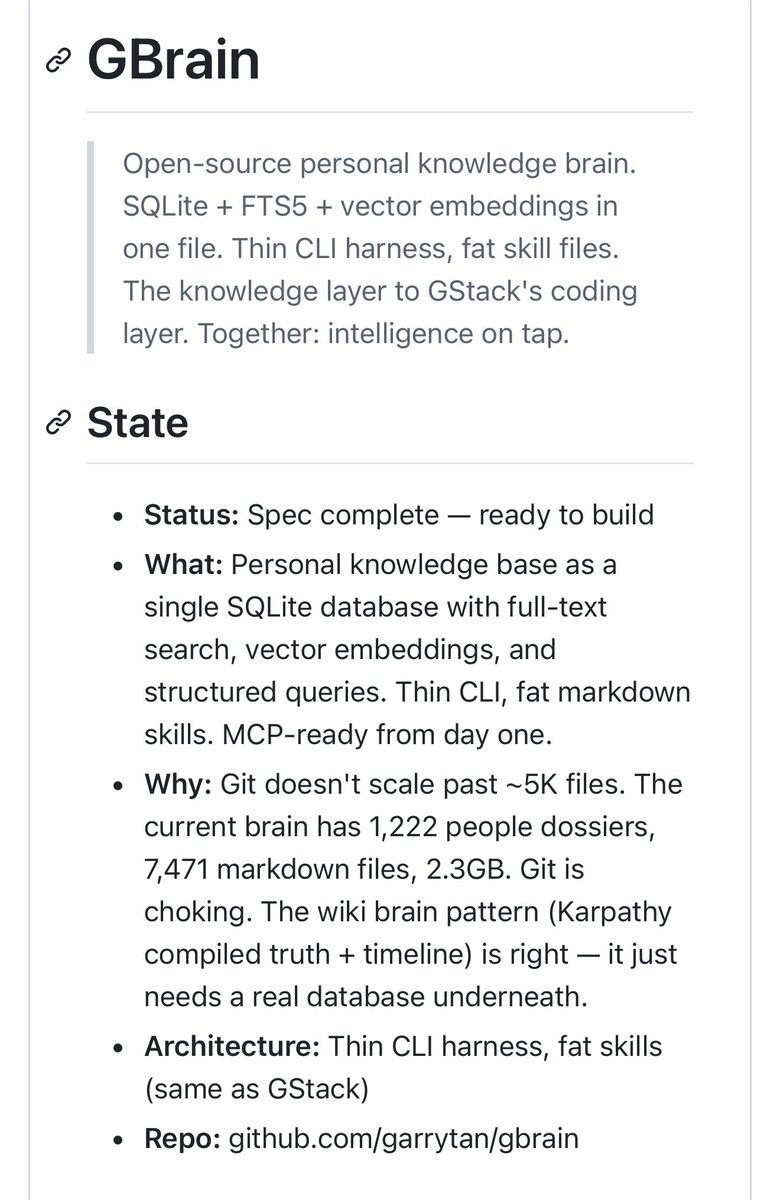
Karpathy-style git wikis for knowledge bases can grow to multi-gigabyte sizes (2.3GB+), at which point git's 5GB limit forces a migration to SQLite — plan for database backends early in long-running knowledge projects (from garry tan openclaw git wiki gstack)
NotebookLM podcast generation combined with a .md analysis file creates a dual-format learning artifact: audio for passive consumption and structured markdown for cross-LLM integration and further querying (from notebook lm podcast markdown analysis)
Prompting Techniques
- "Socratic prompting" -- asking AI questions instead of giving it directives -- is claimed to significantly improve output quality by forcing the model to reason through the problem rather than pattern-match to a response (from socratic prompting technique)
- The technique inverts the typical prompt paradigm: instead of instructing the model, you guide it through questions that may activate deeper reasoning chains (from socratic prompting technique)
- Prompt engineering for domain expertise continues to gain traction -- users want specific, structured prompts tailored to professional workflows (market research, consulting, competitive intel) rather than generic AI interactions (from claude market research prompts)
Research and Analysis
- Claude is being positioned as a market research tool competitive with consulting-grade analysis, with users reverse-engineering prompt strategies from McKinsey and investment bank workflows (from claude market research prompts)
- AI-generated consulting-grade deliverables (McKinsey/BCG-style slides with complex data visualizations) are becoming accessible to individuals, with Kimi generating professional presentations directly from detailed prompts (from kimi mckinsey slide prompt)
- The prompt engineering pattern for high-quality slide generation requires specifying three layers: content structure (frameworks, data types), visual style (typography, color palette), and layout density (from kimi mckinsey slide prompt)
Open-Source Learning
- "GitHub is the new Harvard" frames open-source repos as the primary educational institution for AI practitioners -- credentials matter less than demonstrated learning from public codebases (from most starred ai repos)
- High-star AI repos on GitHub represent a curated, community-validated curriculum -- the engagement signal (stars) acts as a quality filter that traditional education lacks (from most starred ai repos)
Why Coding/Math/Research Outpace General-Use
Karpathy: the dramatic AI improvements in coding, math, and research come from two properties — these domains offer verifiable rewards (unit tests passed yes/no) for RL, and they concentrate B2B value that justifies prioritization; the goldmines drive the focus (from ai capability gap coding vs general use)
The free-tier impression of AI is structurally misleading: free/old/deprecated chat models don't reflect $200/month frontier agentic capability — Codex sessions running 1+ hours can restructure entire codebases or find system vulnerabilities (from ai capability gap coding vs general use)
Visual Training Data for Agents
- Refero's 2,000 DESIGN.md files (colors, typography, spacing, layout patterns from top products) directly address why AI agents make ugly UIs: they've never seen good design — exposure-as-training, packaged for in-context learning rather than fine-tuning (from refero design systems ai agents)
ai-accelerated-learning
- Jason builds custom sites via Codex as personal learning tools (e.g., for learning drums), showing Codex used for rapid single-purpose app generation to support skill acquisition outside of software engineering. (from codex work system jason openai)
structured-writing
- The Pyramid Principle (Barbara Minto, McKinsey, 1985) structures communication in 3 levels: one-sentence answer on top, 2-4 MECE supporting points in the middle, data/proof at the bottom — write answer-first instead of building up like a story. (from pyramid principle claude prompts)
- MECE (Mutually Exclusive, Collectively Exhaustive) is Minto's rule for supporting points: they must not overlap and must together cover the full argument with no gaps — a specific audit criterion for testing document logic. (from pyramid principle claude prompts)
- SCQA (Situation, Complication, Question, Answer) is Minto's 4-sentence framework for document openings: state something the reader already agrees with, name what broke, imply the question, then deliver the recommendation. (from pyramid principle claude prompts)
- Prompt workflow: (1) 'Answer First' prompt converts a messy draft into pyramid form; (2) 'SCQA Opener' prompt writes a 4-sentence opening; (3) 'MECE Audit' prompt flags overlapping/missing supporting points; (4) 'Executive Test' prompt simulates a busy CEO grading whether they'd act, ask, or ignore. (from pyramid principle claude prompts)
- Full workflow takes ~10 minutes: 5 min drafting the pyramid, 3 min for SCQA opening, 2 min MECE audit, 1 min executive test — designed as a repeatable pre-send check for any email, memo, or proposal above a value threshold (e.g. $1K). (from pyramid principle claude prompts)
- Answer-first writing is justified by three measured cognitive effects: lower cognitive load (top-down info processes faster than bottom-up), the primacy effect (readers remember what comes first), and reduced decision fatigue for time-constrained readers like executives. (from pyramid principle claude prompts)
- Historical origin: Barbara Minto (McKinsey's first female MBA hire, 1963) developed the Pyramid Principle while editing Cleveland-office reports; it became mandatory McKinsey training by 1973 and reportedly influenced Amazon's Bezos-mandated 6-page memo format (PowerPoint banned) and is taught at BCG, Bain, and Google. (from pyramid principle claude prompts)
prompting-evolution
- Sam Altman reportedly told Stanford students 'You no longer need to write prompts,' suggesting ChatGPT's newer capabilities (agentic/self-prompting features) reduce the need for manual prompt engineering — claim is unverified/unelaborated in this post. (from altman stanford chatgpt talk)
agent life planning
- Codex can build a full self-paced learning course for a target skill: researching the most effective/fun step-by-step methods, then assembling videos, podcasts, readings, and a checkable schedule into one interactive artifact. (from codex quota burn goal prompts)
AI writing workflow
- Ian Vanagas draws a hard line between 'writing with AI' (using it for research, questions, and feedback while writing all prose himself) and 'using AI to write' (having it generate final text)—arguing the latter leaves 'skeletons of slop' even after heavy editing. (from how i write with ai)
- His research tool stack for sourcing high-quality (non-SEO-gamed) examples: Exa (agent-oriented search), Hacker News (target-audience signal), local PostHog repos/RFCs, PostHog Slack, and Semble (a link-network discovery tool)—mirroring the sources he'd use manually. (from how i write with ai)
AI limitations in writing
- Revealed preference: he never reads AI-generated summaries because compression loses the interesting/unique ideas he's actually looking for; he gets more from a couple of good quotes or skimming the source himself. (from how i write with ai)
- AI is a poor editor for tightening prose: it reflects back whatever framing you give it (e.g., it recommended shortening an already-short intro on nearly every review) and struggles specifically with cutting/rewriting tighter, since it's better at adding than removing. (from how i write with ai)
Voices
39 contributors

Dave Kline
@dklineii
Become the Leader You’d Follow | Founder @ MGMT | CEO Coach | Advisor | Speaker | Trusted by 300K+ leaders. | Work with us: https://t.co/6P5ZGqxCyc

PULKIT WALIA
@WaliaPulkit
Rebuilding FDE Hiring | Founding team @ Urban Company (Seed → $3B IPO) | HBS


Garry Tan
@garrytan
President & CEO @ycombinator —Founder https://t.co/7aoJjp1iIK—designer/engineer who helps founders—SF Dem accelerating the boom loop—haters not allowed in my sauna


Thariq
@trq212
Claude Code @anthropicai. prev YC W20, mit media lab. towards machines of loving grace

Boris Cherny
@bcherny
Claude Code @anthropicai


Nav Toor
@heynavtoor
Helping you master AI daily with step-by-step AI guides, latest news, & practical tools • DM for Collabs


Andrej Karpathy
@karpathy
I like to train large deep neural nets. Previously Director of AI @ Tesla, founding team @ OpenAI, PhD @ Stanford.


Matt Van Horn
@mvanhorn
Co-founded June ("self-driving oven" acquired by @webergrills) & the co that became @Lyft. Building again, more soon. Vibe coding @slashlast30days research tool


Peter Yang
@petergyang
Practical AI tutorials and interviews for busy people | Join 140K+ readers at https://t.co/XYKTmGVH14 | Product at Roblox


Sukh Sroay
@sukh_saroy
Sharing daily insights on AI, No Code, & Tech Tools • Follow me to master AI to level up your life • DM for Collabs


Cody Schneider
@codyschneiderxx
folllow for shiposting about the growth tactics i'm using to grow my startup building @graphed with @maxchehab Get Started Free - https://t.co/stXlkQBlSj


Corey Ganim
@coreyganim
Simplifying AI for non-technical entrepreneurs. Built an eCom biz to $16M+ revenue. Built (then sold) a coaching biz to $340k ARR.


Ihtesham Ali
@ihtesham2005
investor, writer, educator, and a dragon ball fan 🐉


Samantha Trimble
@strimblez
the other sam at openai


vas
@vasuman
Founder and CEO of Varick Agents. Make your company AI native @varickagents


Mayank Vora
@aiwithmayank
AI doesn’t have to be complicated - I’m here to show you how to actually use it and break down the latest trends in AI and Tech.


Kevin Rose
@kevinrose
building all the things | Chairman @digg, Advisor @trueventures | Podcast: Random Show w/ @tferriss. | Ex: @google, Board of Directors: @ouraring, @hodinkee


Nico Bailon
@nicopreme
Building open source agentic tools, mostly for Pi coding agent.


tobi lutke
@tobi
Shopify CEO by day, Dad in evening, hacker at night, Aspiring comprehensivist. + qmd !

Yi Lu
@yyyiiillluuu
TL for Meta AI personalization and agent memory (Reality lab) Former head of ML at Forethought (acquired by Zendesk) Adjunct prof University of Washington


Max Blade
@_MaxBlade
🔥 "QuickClaw" - OpenClaw on your iphone https://t.co/u5NW0xhOZD 📺 YT -https://t.co/lrpw6a0FQQ


Aniket Panjwani
@aniketapanjwani
I teach agentic coding to economists || PhD Economics Northwestern || Director of AI/ML @ Payslice || ex-MLOps @ Zelle
Anish Jaitwar
@AnishJaitwar


Mike Bespalov
@bbssppllvv
Making AI design not suck. Founder of @referodesign (250K+ users). Ex- @clerk


Crystal
@crystalsssup
@Kimi_Moonshot Staff. UCSD Alum. Personality goes a long way. Be useful.
Khairallah AL-Awady
@eng_khairallah1


Eth
@EtherCoins
Bitcoin evangelist | Alts observer | Blockchain enthusiast since 2013 | AI visuals & engineering | Fitness adept | Financial analysis =/= advice


Machina
@EXM7777
running ai-powered agencies | https://t.co/fMOmHWBgHG
Forward Future Brian
@ForwardEditor


Griffin Hilly
@GriffinHilly
Bond trader by day, pro-humanism/nuclear on my own time. @MadiHilly’s biggest fan


Hasan Toor
@hasantoxr
AI & Tech Educator • Sharing insights & practical ways to use AI & Tech Tools for you & your daily business


Rimsha Bhardwaj
@heyrimsha
Helping you master AI daily with step by step AI guides, & practical tools • AI Educator & Writer • DM for Collab
Ian Vanagas
@IanVanagas


jayson
@jaezun_
building new interfaces slack for agents – https://t.co/OftncoyECM (a16z sr) language simulations – https://t.co/xOdU5WuT0B prev @palantirTech @notionhq cl

rahul
@rahulgs
head of applied ai @ ramp


Ryan Hoover
@rrhoover
Founder of @ProductHunt. Investor at @WeekendFund. Say hi! 👋🏼


Shrey Pandya
@shreypandya
building @browserbase // @neo, @v1michigan 〽️


Tech with Mak
@techNmak
AI, coding, software, and whatever’s on my mind.


Teknium 🪽
@Teknium
Cofounder and Lead Engineer - Hermes Agent @NousResearch, prev @StabilityAI Github: https://t.co/LZwHTUFwPq HuggingFace: https://t.co/sN2FFU8PVE